
The major trading centers of the Viking Age – Birka, Hedeby, Kaupang, and the island of Gotland – were not accidental settlements but key nodes of the northern world. They were founded on lakes, deep inside fjords, and in sheltered bays, where trade could be controlled and defended. Silver, furs, walrus ivory, iron, glass, and crafted goods changed hands here. These markets functioned under law and authority, yet disappeared when routes shifted, shorelines changed, or political balance collapsed.
At first light, the quay comes alive. A merchant drops to one knee and unfolds his folding scales, leveling the pans with a practiced motion. Silver settles into them heavily, without shine. Here, appearance means little – only weight matters. Around him, different tongues are heard: the sharp consonants of Frisian speech, the drawn-out rhythms of Slavic voices, unfamiliar words from men who came from the south. No one raises their voice. In a market, people speak quietly, because every word has a price.
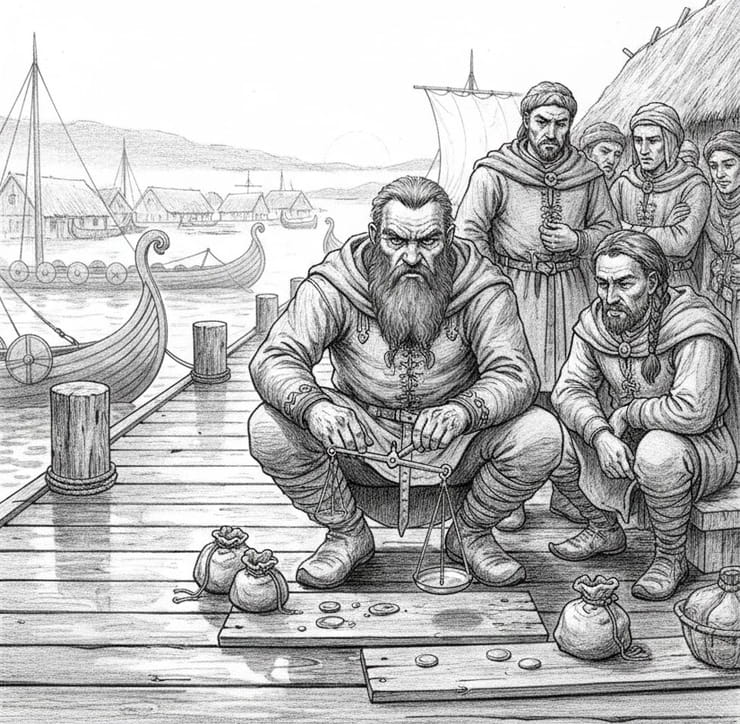
Pouches of dirhams pass from hand to hand. Nearby, furs, iron, and glass find new owners. No one asks where you came from – what matters is what you brought. Everyone understands that this place survives on balance. As long as silver is weighed honestly and agreements are kept, the market lives. In the restrained glances and silent counting lies the whole world of the Viking Age – a world where wealth and danger always stand side by side, separated only by the width of a palm.
The Viking Trading Town
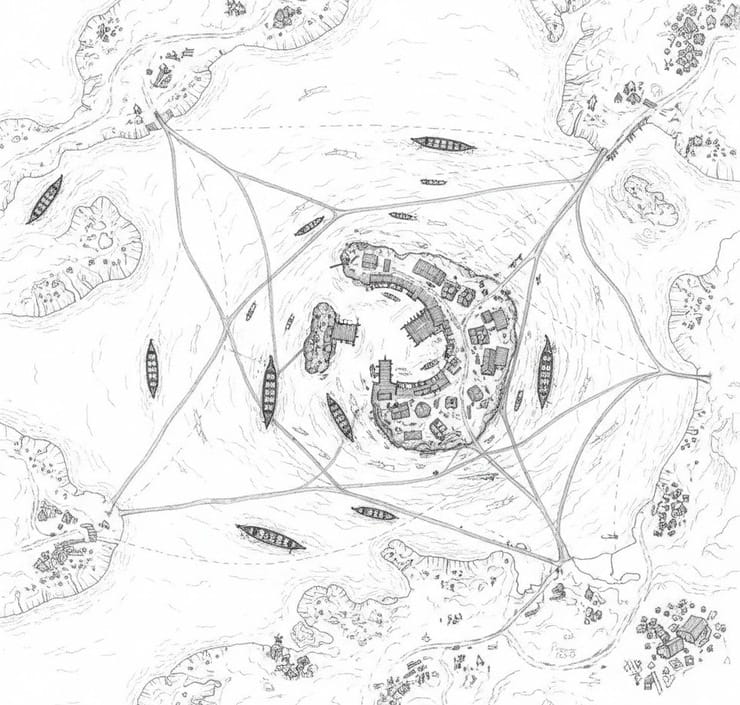
When we hear the word city, we imagine walls, streets, and the constant noise of daily life. Viking trading towns were not like this. They were not born as capitals and did not exist to rule territory. They were meeting points – places where routes, languages, and interests crossed. A person might stay for a month, a season, or a single day, then vanish with his ship. To understand these towns, one must see them not as settlements, but as nodes: moments of intense concentration where the entire northern world briefly came together.
Why Markets Were Built Inside Fjords and Lakes
Security was decisive. Markets rarely appeared on open coasts. Instead, they were placed deeper inland – inside fjords, along lake shores, or within sheltered bays. Such locations were easier to control. Ships could be seen from afar, access was limited by water, and sudden attacks became less likely. Geography itself became the first line of defense for trade.
Silver, Law, and Protection
Trade cannot exist without trust. Silver required scales and standards, deals required rules, and markets required protection. Local rulers provided order: collecting dues, establishing laws, and guaranteeing safety. Where law existed, exchange could become regular and predictable.
In a foreign town, you were either under the protection of the law – or you were prey. There was no third path.
It was these nodes – protected, regulated, and embedded in a wider network of routes – that formed the backbone of the Viking trading world. The first legend of that network was Birka.
Birka – A Gateway to the Western World
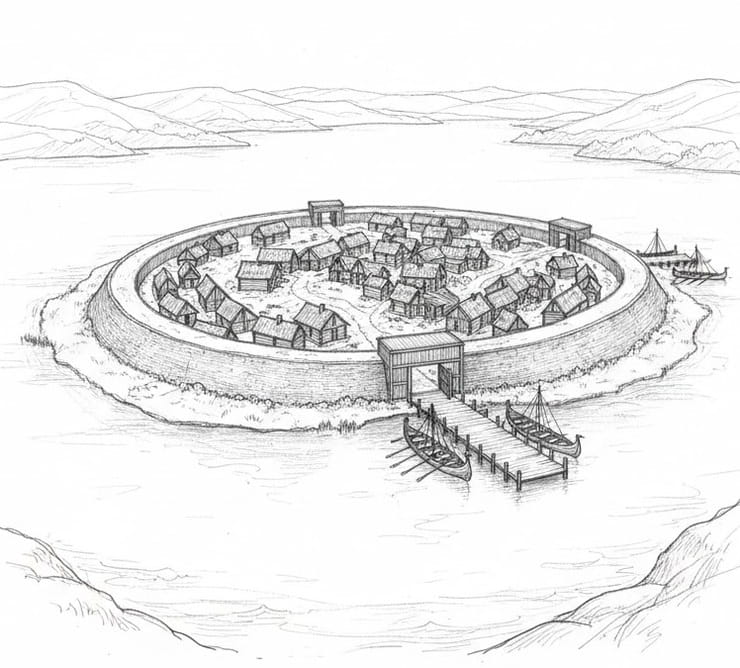
Birka was not located on the open sea. It stood on the island of Björkö, in Lake Mälaren, in an area contemporaries called Black Earth. The name itself speaks of long human presence – layers of ash, organic remains, and refuse accumulated over generations of merchants and craftsmen. Water routes from the Baltic led here, yet the town lay hidden deep within a lake system, shielded from the open coast.
Our primary “voice” of Birka is the Vita Ansgarii, written by Rimbert. In this text, the town appears not as an abstract marketplace but as a living place: with a thing where decisions were made, with local elites and jarls, among them Hergeir – a figure connected at once to authority, trade, and religion. Through Rimbert’s account, Birka becomes a viewing chamber into the ninth-century northern world. We see a town trading with Dorestad in the west, receiving foreigners, debating belief, and preparing for danger.
That danger was real. Rimbert describes an attack during which the inhabitants of Birka took refuge behind their defenses. Archaeology confirms his account. The town was surrounded by an earthen rampart, with gates leading directly to the ship landings. A coin found beneath the rampart allows its construction to be dated. The defenses were not an afterthought. They appeared at the moment when accumulated silver demanded protection.
Yet even fortifications could not halt slow geographical change. The water level of Lake Mälaren shifted. Land uplift gradually altered the shoreline. What had once been a convenient harbor slowly lost its connection to the main routes. Birka remained in place, but the world around it moved.
This change is visible in the archaeological record. In the early phase, during the eighth and ninth centuries, imports are oriented primarily toward the West-Frankish goods, glass, and objects from the North Sea world. By the tenth century, eastern goods appear more frequently: dirham silver and signs of a shifting commercial axis. The town changed as the network it belonged to changed.
Then came silence. Coins from later periods are almost absent. By the end of the tenth century, Birka ceased to function as an active center. The reasons remain debated: altered routes, political destruction, loss of position within the network, or a deliberate abandonment. Somewhere in the ground, silver may still lie hidden – buried in a moment of danger and never recovered.
One can imagine a scene: a missionary steps onto Birka’s quay. Wet planks beneath his feet. Around him, pouches of silver, Thor’s amulets, and the constant murmur of bargaining merchants. A new faith cautiously tests the language of the market, uncertain whether it will take root here.
Birka was a place where the West spoke directly to the North for the first time. But before Birka, there was Helgö – and that fact changes how we understand the beginning.
Helgö – Trade Before the Viking Age
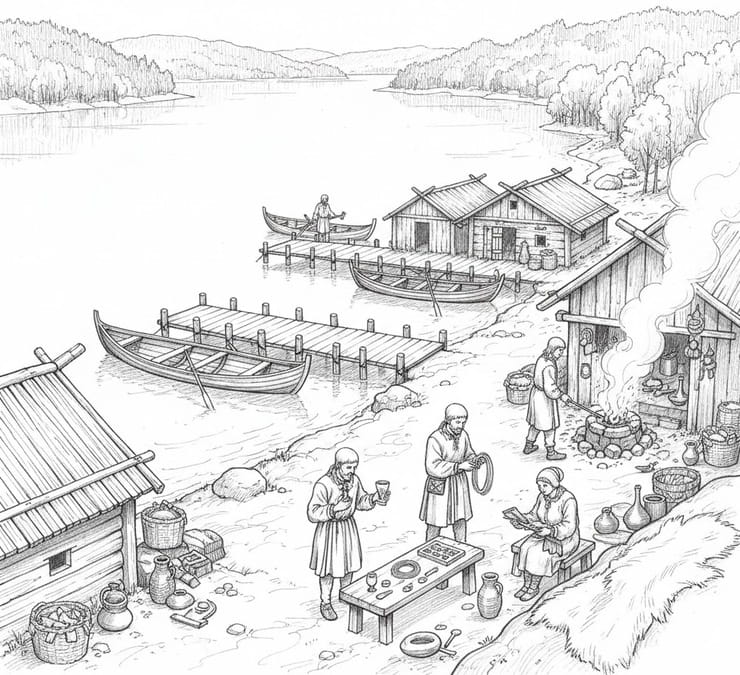
Long before Birka became a name known beyond Scandinavia, there was Helgö – a settlement already embedded in long-distance trade networks. Helgö emerged earlier than the classic “Viking towns” and shows that a market does not appear suddenly or without preparation.
The archaeological finds from Helgö look almost unexpected for their time. Objects arrived here from very distant regions: glass vessels, fine metalwork, and ornaments that do not belong to local traditions. These were not random trophies, but traces of sustained contact. They indicate that the people of Helgö were part of a wide exchange network long before the era of large-scale maritime expeditions.
Equally important is that Helgö was more than a transit point. Craftsmen worked here, metal and glass were processed, and objects were produced that later circulated further along the routes. It was a center of skills and knowledge, not merely a meeting place for merchants. Settlements like this created the foundation upon which larger and more organized markets could later grow.
Why, then, did Helgö give way to Birka? The answer likely lies not in decline, but in a shift of focus. Routes changed, protection became more important, and trade required clearer organization and authority. Birka offered a more convenient harbor, fortifications, and a different scale. Helgö faded into the background not because it was unimportant, but because it had fulfilled its role earlier.
Helgö reminds us that a trading town never emerges from nothing. There is always a prehistory – quiet, scattered, and almost invisible. Without it, explosive growth is impossible.
Kaupang (Skiringssal) – A Market in a Quiet Bay
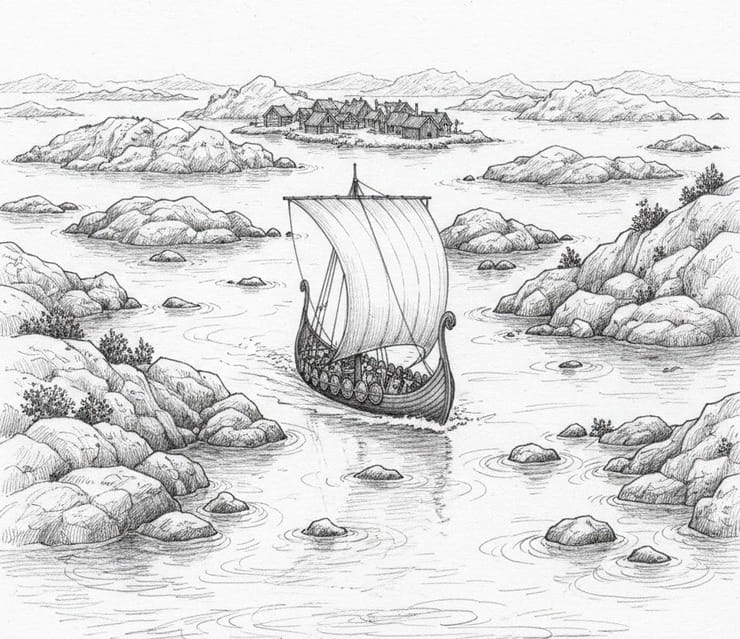
Today, the place where Kaupang once stood looks deceptive. Shallow waters, marshy ground, and a calm landscape in which it is hard to imagine a bustling market. But during the Viking Age, the shoreline was different. The water level was higher, and the bay formed a sheltered harbor – deep enough for ships and protected enough to withstand the storms of the Skagerrak.
The entrance to this harbor was both defense and trap. An archipelago of islands and shoals concealed the approach. For those who knew the way, it was a safe refuge; for outsiders, a deadly maze. Without knowledge of the channels, a ship could easily run aground or break against the rocks. A pilot here was not a luxury, but a necessity. This geography made Kaupang an ideal place for trade. Those who arrived were expected.
Archaeology speaks of intense activity along the shore. Layers of so-called “black earth,” rich in organic remains and traces of human work, point to heavy use of the site. Jetties arranged in a curve along the water have been found, along with sections of waterfront and traces of buildings. Scholars still debate whether these structures were permanent dwellings or seasonal constructions linked to fairs. The truth may lie between the two: some people lived here year-round, others came only for the trading season.
Kaupang was not only a market, but also a place of production. Metal was worked here, textiles were made, and soapstone was used for vessels and household goods. Evidence of glassworking has been found, along with imported pottery from distant regions. All this points to a complex economy in which goods were not merely exchanged, but also produced on site.
Silver arrived by many routes. Among the finds are Arabic dirhams and other coins, proof that Kaupang was integrated into long-distance trade networks. Through this quiet bay flowed wealth that sustained Norwegian communities and linked them to a world beyond the horizon.
The people of Kaupang were diverse: merchants, sailors, craftsmen, and farmers from nearby farms. Some came for a season, others stayed longer. It was not a city in the conventional sense, but a node where routes and lives intersected.
The end of Kaupang was as quiet as its existence. A falling water level rendered the harbor unsuitable for ships. What had once protected the market ultimately deprived it of a future. Trade moved elsewhere. Kaupang lived for about a hundred years – and vanished as quietly as it had appeared.
Gotland – The Island of Silver
Chroniclers rarely wrote about Gotland. In the annals of history, it does not appear as a stage for great battles or as a seat of kings. There are no famous missions like those in Birka, no treaties concluded by rulers, no dramatic turning points recorded in words. And yet this island became one of the richest places in the northern world. Its story survived not in texts, but in the ground – in silver buried and never reclaimed.
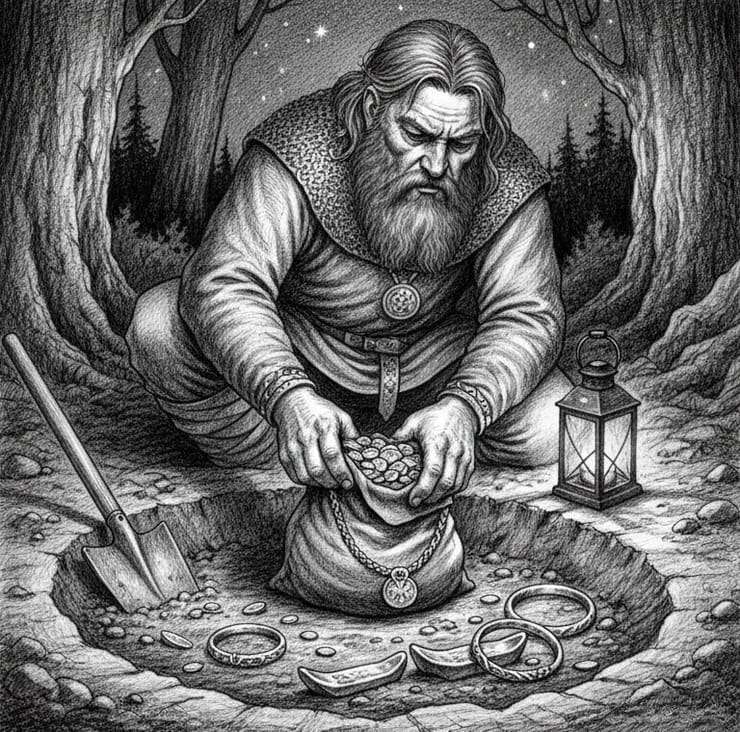
The strongest evidence of Gotland’s wealth lies in its hoards. Hundreds have been found here. These are not coins casually lost at a market, but carefully hidden deposits: silver dirhams, Western European deniers, ingots, jewelry. The numbers are striking. No other region in Scandinavia has produced so much silver per square kilometer. This was not a brief moment of fortune, but the result of long-term, systematic trade.
Why here? The answer lies in profit and risk. Gotland sat at the center of the Baltic, at the crossroads of major routes. From the island, merchants could sail east toward Ladoga and Novgorod, where river systems led deep into the continent, or south across the Baltic toward the lands of future Germany, rich in metals and connected to the markets of Western Europe. A trader leaving a Gotlandic harbor had options – and could change course quickly as demand or danger shifted.
Profit was high precisely because the route was dangerous. The Baltic of the Viking Age was no peaceful trading lake. Competitors, pirates, and armed groups from other trading communities operated here. Gotlanders responded with speed and experience. Their ships were fast, their crews accustomed to risk, and their knowledge of routes was passed down like family capital. Risk was repaid in silver.
During the Viking Age, Visby was not yet the stone-built town known from later centuries. It was closer to a “foreign harbor” – a place where no one was fully local, and where trade flowed precisely because of that distance. People did not settle here permanently; they returned. Visby was a meeting point, a market without proclamations, where deals were concluded faster than chroniclers could record them.
Gotland’s memory is also preserved in its picture stones. They differ from the rune stones of mainland Sweden. Carved into them are ships under sail, battle scenes, riders, warriors, and mythological imagery. These were not mere decorations. They formed a visual narrative of a world where sea, journey, and wealth were inseparable. The stones reminded those who passed them that it was the ship – and the risk it carried – that brought prosperity home.
Imagine a landowner stepping beyond his farm late in the evening. He digs a shallow pit, places a pouch of silver inside, and carefully covers it with soil. “Just for one night,” he thinks. Tomorrow may bring danger; tomorrow he may have to sail. He does not know that he will never return. His hoard will lie in the earth for a thousand years – and become, for us, an archive of the age.
Gotland reveals another side of the Viking world: quiet, calculated, and extraordinarily profitable. This was not a place where power over land was sought. It was a place where wealth was made by moving silver. And if Gotland represents sea and profit, then Hedeby represents borders and control.
Hedeby – A Node Between East and West
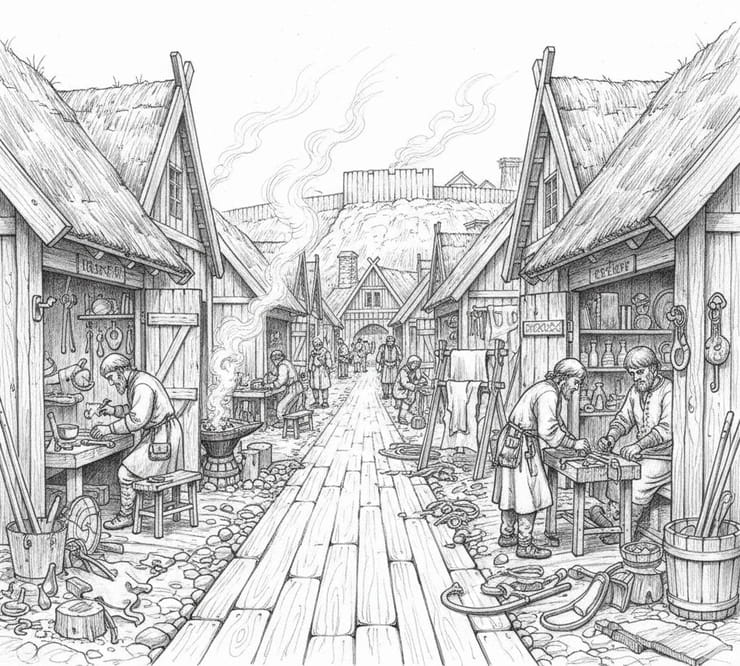
Hedeby did not emerge simply as a market, but as a point where worlds intersected. In historical sources it appears under different names—Hedeby, Heiðabýr, Haithabu—and this variety alone reflects its role. The town stood at the meeting point between the Baltic and the North Sea, between Slavic and Scandinavian spheres, between East and West. Routes converged here, carrying goods, ideas, and people who spoke different languages and lived by different laws.
Its rise coincided with a major shift in global trade. The Mediterranean system, which for centuries had linked Europe to the East, gradually gave way to northern routes. Increasing amounts of silver, goods, and people began moving through the Baltic Sea. Hedeby stood precisely where these flows could be gathered, redirected, and controlled.
We know how this network functioned not only through archaeology, but also through rare written testimonies. At the court of the Anglo-Saxon king Alfred, the accounts of two northern seafarers – Ottar and Wulfstan – were recorded. Their texts read like two lines drawn across a map. Ottar traveled from the far north, from Hålogaland, describing a world of furs, reindeer, and distant seas. Wulfstan spoke of the eastern Baltic, Slavic lands, and river routes leading toward the wealth of the continent. In both narratives, Hedeby appears naturally – as the place where such routes converged and turned into a market.
Politics mattered here no less than geography. Danish kings understood the value of the town early on. According to the sources, the ruler Godfred did not merely strengthen Hedeby, but deliberately eliminated rival centers such as Reric, forcibly relocating craftsmen and merchants. The logic was simple: trade must not be allowed to bypass you. Control over the market meant control over silver – and silver meant power.
This is why a massive defensive system, the Danewirke, rose alongside the trading town. It was more than a rampart; it was a boundary between worlds. It protected the southern approaches and declared that beyond this line, trade and authority were under control. Hedeby required defense as much as it required a harbor. Without walls, a market became prey.
Archaeology allows us to see the town from within. A semi-circular rampart enclosed the settlement, inside which lay quarters of craftsmen. Wooden houses, plank-paved streets, piers, and warehouses all point to permanent habitation rather than a seasonal fair. Blacksmiths, leatherworkers, jewelers, bone and wood craftsmen worked here side by side. Finds of coins, scales, and imported materials reveal intense exchange – Arab silver, glass, ceramics, and goods from distant regions.
Everyday life in Hedeby was layered and complex. In one house metal was cast; in another, textiles were traded; in a third, ship fittings were repaired. Alongside this economic activity existed religious plurality. Archaeologists have found molds for casting both Thor’s hammers and Christian crosses. Paganism and Christianity did not collide head-on here – they coexisted, because the market demanded tolerance. A merchant did not ask about faith as long as the deal was fair.
The town was also described by the Arab traveler al-Tartushi. He noted the harsh climate, customs, and ways of life, sometimes exaggerating their strangeness. His account cannot be read literally, but it remains valuable as an outsider’s perspective – showing how Hedeby appeared from afar: wealthy, remote, and unfamiliar.
The end came swiftly. In the mid-11th century, amid conflicts associated with the campaigns of Harald Hardrada, Hedeby was destroyed. Trade routes shifted, political balances changed, and rebuilding no longer made sense. The role of the node passed to other centers. Hedeby itself became a layer of “black earth” beneath the grass.
Why Some Trading Centers Survived While Others Disappeared
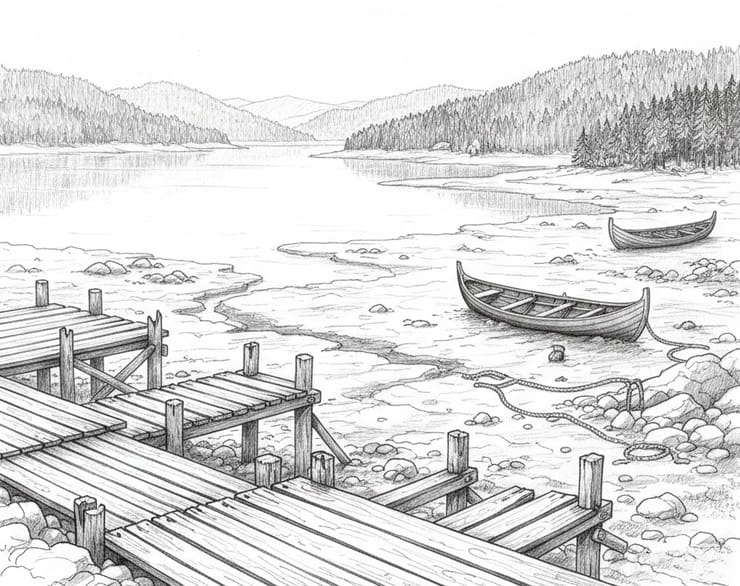
The fate of a trading town was rarely decided by a single event. A market could flourish for decades and then fade almost without a trace. The reasons were varied and usually intertwined – geography, politics, war, shifting routes, and the strength of law.
The first factor was nature itself. Northern Europe lived by the rhythm of slow but relentless changes in sea level. In the Baltic region, land uplift gradually reshaped coastlines. A harbor that once welcomed seagoing vessels could, a century later, become too shallow for large ships. Fjords turned into marshy lagoons; channels narrowed into streams. For a trading center, this meant losing its greatest advantage – access to the sea. Without a deep-water harbor, a market slipped out of the network and began to decline.
The second factor was war and politics. A trading town always stood at a crossroads of interests. It attracted silver, craftsmen, and people – and therefore became a desirable target. Changes of power, internal conflicts, or external attacks could destroy infrastructure or make a place unsafe for merchants. Even without total destruction, the loss of protection by a strong ruler was often enough for trade to seek a calmer harbor elsewhere.
Routes, too, were never permanent. Trade is movement, and movement responds to risk, demand, and political conditions. When a route became too dangerous or unprofitable, merchants adapted. Shifts in silver flows, changes in connections with East or West, or the rise of a new, better-situated port could weaken an established center. Competition between towns was real. The market that offered greater speed, safety, and lower costs survived.
There was also a quieter but decisive factor – law. Trade requires trust. A merchant must know that robbery will be punished, disputes resolved, and debts enforced. This is why protection by authority mattered. A well-known example is Birkalagen, the set of rules governing trade and the legal status of merchants around Birka. Such frameworks created predictability. In a foreign town, you were either under the protection of law—or prey. When legal order weakened, the market began to fracture.
The history of northern markets shows that trade rested not only on ships and silver, but also on shorelines, power, and law. Where these elements held together, a town endured. When they failed, even the richest market could quietly disappear.
Frequently Asked Questions About Viking Trading Centers
What were the largest Viking trading centers?
The key hubs of the Viking Age trading network included Birka on Lake Mälaren, Hedeby at the junction of the Baltic and North Seas, Kaupang in southern Norway, and the island of Gotland, with its main harbor at Visby. These places were not political capitals. They functioned as nodes of exchange through which goods, silver, and people moved.
Why did Birka and Hedeby have defensive ramparts, while Kaupang did not?
Birka and Hedeby concentrated large amounts of silver and were exposed to constant threats, which made clearly defined defenses necessary. Kaupang, by contrast, lay deep inside a complex harbor of islands and shoals, where geography itself acted as protection. Water and difficult access partly replaced walls.
What goods were traded in Birka, Hedeby, and Kaupang?
These centers handled furs, walrus ivory, iron, amber, glass, ceramics, and slaves. In return, Scandinavians acquired silver coins, textiles, jewelry, and luxury goods. Hedeby was especially important as a crossroads between eastern and western trade flows, while Birka initially focused on the West and later shifted toward the East.
Why did Gotland become the main “island of silver”?
Gotland stood at the center of Baltic routes connecting Eastern Europe, Scandinavia, and the German lands. The enormous number of silver hoards – containing Arabic dirhams and Western coins – shows that the island was not merely a transit point, but a place where wealth accumulated. High risks at sea were balanced by high profits.
Who was Rimbert, and why is his text important?
Rimbert was a ninth-century Christian missionary and the author of Vita Ansgarii, one of the most important written sources on Birka. His work provides a rare, contemporary description of the town – its assembly (thing), governance, and religious tensions – allowing us to see a trading center through the eyes of someone who was there.
What was a thing?
A thing was an assembly of free people where legal, political, and economic matters were decided. Disputes were settled, laws proclaimed, agreements confirmed, and rulers’ decisions validated. For trading centers, the thing was crucial: it provided the legal framework of exchange. Merchants could expect conflicts to be resolved by rules rather than force. In this sense, the thing was a foundation of trust without which a market could not function.
What was Birkalagen, and why was it needed?
Birkalagen was a body of rules regulating trade and the legal status of merchants in the Birka region. It offered protection to people and transactions involving traders from afar. Such law created predictability – merchants knew they were under the protection of authority while trading there.
Why did Hedeby disappear, while Schleswig survived?
Hedeby suffered from warfare and was destroyed in the mid-eleventh century. As trade routes shifted and political conditions changed, rebuilding no longer made sense. Nearby Schleswig proved better positioned within the new network and inherited Hedeby’s commercial role, while Hedeby itself faded into history.
What are the storms of the Skagerrak, and why were they dangerous?
The Skagerrak is the strait between Norway, Denmark, and Sweden, notorious for sudden storms and strong currents. A single storm could destroy a ship within hours. Yet these waters lay on crucial trade routes, and facing this danger was part of the price paid for access to the markets of the North Sea and the Baltic.
Why were Viking trading centers often located away from the open coast?
Inner harbors – inside fjords, lakes, or behind islands – were easier to defend. They allowed control over access, reduced the risk of surprise attacks, and gave merchants a sense of security, without which regular trade could not exist.
Can Viking trading towns be considered true cities?
Not in the modern sense. They were places of concentrated exchange, where some people lived permanently and others arrived seasonally. Their importance was defined not by population size, but by their role within networks of routes and silver flows.